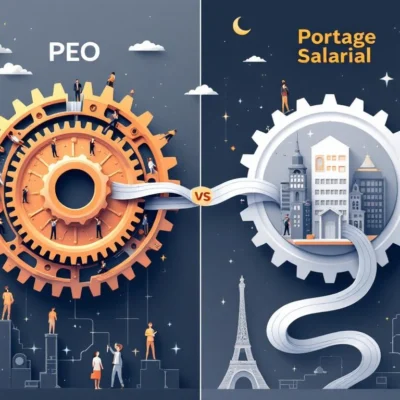
Portage Salarial vs. French Employment Law in France: Which is Right for Your Business?
最新消息: 6 月 早在2013年,谷歌就推出了Google+,旨在让人们能够更轻松地分享信息,并与他人建立联系。 由 国际就业专家
Expanding into the French market requires more than simply finding qualified talent. International companies must navigate strict labor regulations, payroll obligations, social security contributions, and worker-classification requirements.
To simplify hiring in France without opening a local entity, many businesses consider two flexible workforce models: portage salarial and an EOR solution in France.
Although both approaches help companies engage workers compliantly, they are designed for different business needs and employment structures.
This guide explains the main differences between portage salarial and an EOR solution in France, including compliance considerations, operational flexibility, and which model may be better suited for international expansion.
Understanding Portage Salarial in France
Portage salarial is a French-specific employment framework created primarily for independent consultants and highly skilled professionals. It combines elements of freelancing with employee protections under French labor law.
The structure typically involves three parties:
- the client company;
- the portage company;
- the consultant or freelancer.
The professional performs services for the client while the portage company handles payroll processing, invoicing, social contributions, and employment administration.
Portage salarial is commonly used for:
- IT consulting;
- engineering projects;
- business consulting;
- project management;
- design and creative services;
- translation and specialized freelance work.
What Is an EOR Solution in France?
An EOR solution in France allows international companies to legally hire employees without establishing a French subsidiary or branch office.
Under this model, the Employer of Record becomes the legal employer on paper while the client company manages the employee’s daily work responsibilities.
一个 EOR solution in France typically manages:
- 当地就业合同;;
- 薪资管理;;
- 扣税;;
- social security compliance;
- 员工福利;;
- onboarding and HR documentation;
- statutory leave requirements;
- labor law compliance.
This model is often used by companies expanding internationally, building remote teams, or testing the French market before opening a permanent entity.
Key Differences Between Portage Salarial and an EOR Solution in France
Worker Classification
Portage salarial is designed mainly for independent professionals who maintain a degree of operational autonomy.
An EOR solution in France supports standard employment relationships for both temporary and long-term employees.
Employment Flexibility
Portage salarial works best for project-based consultants and freelance specialists.
An EOR solution in France provides broader hiring flexibility and supports:
- 全职员工;;
- remote workers;
- management positions;
- operational staff;
- international team expansion.
合规管理
Portage companies manage payroll and social contributions for consultants.
An EOR solution in France typically offers wider compliance support, including:
- employment law guidance;
- mandatory benefits administration;
- HR compliance;
- onboarding documentation;
- 终止程序;;
- payroll tax management.
Business Scalability
Portage salarial is generally better suited for hiring a limited number of independent specialists.
An EOR solution in France is often more scalable for businesses planning broader workforce expansion or long-term operations in the French market.
When Portage Salarial May Be the Right Choice
Portage salarial may be suitable for companies that:
- need temporary consultants;
- hire highly skilled freelancers;
- require short-term expertise;
- want flexible project-based cooperation;
- work with professionals who prefer independent structures.
It is especially popular in consulting, technology, and specialized advisory industries.
When an EOR Solution in France Makes More Sense
An EOR solution in France is often a stronger option for businesses that:
- want to hire employees quickly in France;
- do not have a French legal entity;
- need long-term workforce stability;
- require compliant payroll and HR management;
- want to reduce employment compliance risks;
- plan international expansion across multiple countries.
This structure helps companies enter the French market faster while reducing administrative complexity.
Compliance Considerations for Hiring in France
French labor regulations are highly protective of employees and contain strict requirements regarding:
- 劳动合同;;
- 薪资报告;;
- 社会贡献;;
- 法定休假;;
- 终止程序;;
- worker classification.
Improper contractor classification can expose companies to:
- 罚款;;
- backdated contributions;
- 劳动争议;;
- regulatory investigations.
Because of these risks, many international companies choose structured hiring solutions that provide stronger compliance oversight.
Choosing Between Portage Salarial and an EOR Solution in France
The best hiring structure depends on:
- the type of workforce needed;
- project duration;
- operational control requirements;
- compliance priorities;
- long-term business goals in France.
Portage salarial may work well for independent consultants and project-based assignments.
An EOR solution in France is generally more suitable for companies seeking compliant long-term hiring, operational scalability, and simplified workforce management without establishing a local entity.
Businesses expanding into France should evaluate both models carefully to ensure alignment with local regulations and international growth objectives.